
More Than an Electrician
Every morning before work, John Ghitui glances at the old violin stored above the bed he shares with his twin brother. Battered but beloved, it is his most precious possession—a purchase he saved three months for, even though it was second-hand and cost next to nothing. He has cherished it ever since.
In an ideal world, John would practice right away. But his alarm clock sounds at 5am, and the walls in his cramped apartment in southwest Nairobi are paper-thin.
“When I wake up, most of my neighbors are still asleep,” he says, smiling ruefully. “So when you start practicing in those morning hours, they’ll be very, very mad at you.”
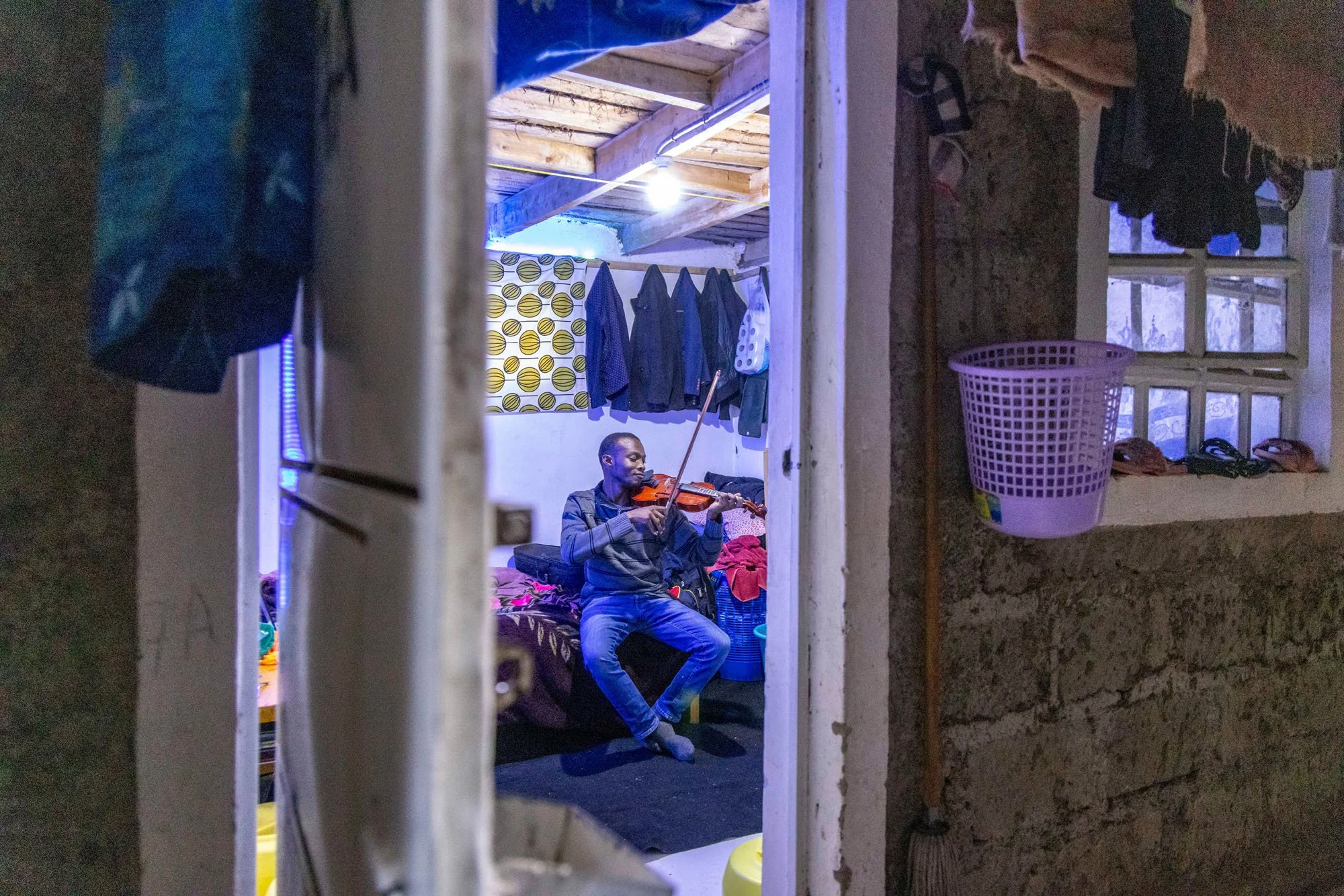
Before work each day, John Njui steals a quiet moment to look at his battered second‑hand violin—the treasured instrument he spent three months saving for and has cherished ever since.
Instead, with a sigh, he showers, grabs a quick breakfast and steps out into the pale light of the African dawn. Ducking under laundry strung along the building’s ground floor, he emerges onto the bustling street as a cockerel crows in the distance.
John’s daily commute to his construction site in Nairobi’s affluent Spring Valley district involves two nerve-wracking rides on Kenya’s matatus—the unruly minibus taxis notorious for ignoring the rules of the road.
Now in his second year as an apprentice on the PropelA vocational training program—an initiative launched in 2022 by the Hilti Foundation and its partners—John is gaining the kind of hands-on experience he once only dreamed of.
Arriving on site at 7.30am, his days are busy: wiring lifts, installing generators, dressing distribution boards. At the age of only 22, he is already trusted with work once reserved for seasoned technicians.
“The second year has been really different because the foremen recognize you,” says John. “They give you the same responsibilities. That is really motivating because it means they can see you are going in the right direction.”
PropelA is John’s second vocational course. The first, a two-year program in electrical wiring, left him frustrated and underprepared.
“It was mostly theory,” he says. “Sometimes we spent a whole day just reading textbooks. And if we did get a practical, it was something very basic.”
Worse still, after 18 months, he was expecting to secure a 12-week internship on his own. But no company would take him.
“On paper I had the training,” he says. “But in reality, I didn’t know what I was doing.”
In contrast, PropelA blends theory with practice: three weeks a month working with a company, and one week in the project’s workshop. The program even provides a stipend and active mentorship.
“I had friends already doing the PropelA course,” John says. “We used to compare notes and I saw that what we were taught did not really compare.”
So he applied to PropelA and was thrilled to be accepted. From the start, he learned skills that employers value—technical drawing, AutoCAD software, modern installation techniques. Within months, his confidence soared.
He knows how fortunate he is. One million young Kenyans enter the labor market each year. But only 20 percent secure regular jobs. The country has one of the highest youth unemployment rates in sub-Saharan Africa, according to the World Bank. Graduates lacking the practical skills needed in today’s work environment is a contributing factor. A 2021 survey by the Kenya National Bureau of Statistics found that more than 60 percent of employers believe vocational training program graduates lack sufficient hands-on skills.
John may well escape that fate—a remarkable achievement considering his upbringing in Kenya’s Rift Valley, where poverty was a daily reality. His parents, subsistence farmers, sometimes paid his school fees by supplying produce to the head teacher. When crops failed, John and his brother missed lessons. At home, studying was done by the rationed light of a kerosene lamp.
At school he was teased for his family’s financial struggles—yet his leadership qualities eventually earned him the position of student president. He dreamed of being an engineer or a teacher, but higher education was always out of reach. PropelA was a life saver. Winning a place on the course saved him from potential ruin, he believes.
“PropelA really changed my life,” he says. “It gave me skills, but also self-belief. It also helped me to avoid being idle in a country where idleness has forced many youths into crazy and desperate things like drugs and crime.”
Now John is thriving. Apprenticed to Ultra Power Systems, a partner in the PropelA program, he receives a stipend that allows him to rely less on his parents for his rent and matatu fare. He and his brother, a cabinet maker, have been able to rent a place in a relatively safe area, one that has access to electricity and communal showers. For the first time in his life, John can more or less fend for himself.
To him, the PropelA program is a stepping stone to a better future, one that should enable him to secure a steady, rewarding job. In time, perhaps, it may even lead to starting his own business.
“Thanks to PropelA I really see the light at the end of the tunnel,” he says. “And not just for me. My goal is to one day start my own company so that I can give back to society in the way that PropelA gave to me. I want to help other young people who never got a chance like this.”
At the end of the working day, John returns to his beloved violin. Although he has only been playing it for six months—inspired by hearing the strings ensemble at his local church, which offers free lessons—it has already become central to his life. Twice a week he practices at the church’s “Tchaikovsky Club” and he has begun performing during services.
“I love the violin because you play it with your mind, with your soul and with your whole concentration,” he says. “Everything is focused into that one instrument.”
And thankfully, he adds, the neighbors don’t mind so much when he plays in the evenings. Even when he hits a wrong note, no one complains. He is making music—and a future.